

Glass reactors are essential industrial and laboratory equipment that are used for providing and maintaining ideal conditions for chemical reactions. They consist of a transparent vessel that contains the reactants and is the place where the reaction takes place. Other than the vessel, the reactor contains drain valves, seals, multiple sensors, agitators, and more.
Depending on the type of glass reactor, it may also be equipped with an Cylindrical double-layer reactor vessel, referred to as a jacket.The jacketed glass reactors circulate a heating and cooling medium in this outer layer(jacket) to precisely control the reaction's temperature.
The single-layer glass reactor is just a spherical single-layer glass reactor body that needs to be heated by a heating device to provide a heat source.

The blog explores and compares the significant parameters of a single-layer and jacketed glass reactor to help you choose what's ideal for you.
Single-Layer and Jacketed Glass Reactor – Key Differences
The most popularly used types of glass reactors are single-layer and jacketed. They work on the same basic principle-using critical parameters to control the rate of chemical reactions. However, they both differ in design, temperature control, and other factors. Understanding the difference between the two types of glass reactors will help your decision-making. As a result, you can save yourself from spending unnecessary time and resources by choosing the right one. The key differences are given below:
1. Design and Working
The basic difference between single-layer and jacketed glass reactors is in the design. A single-layer glass reactor consists of a Single layer spherical glass body without any outer covering,and match with heating mantle or heating oil bath. Meanwhile, a jacketed glass reactor comes with an cylindrical outer layer that circulates the heating and cooling medium. The design of a jacketed glass reactor is more complex and comes with additional components that control the heating or cooling medium.
|
|
 |
| Jacketed glass reactor image | Single layer glass reactor image |

2. Cost and Energy Consumption
Due to additional functionalities, jacketed glass reactors are more expensive and have a higher operating cost. The complexity of glass reactors increases with the introduction of an extra layer(the jacket). Therefore, a jacketed glass reactor has a higher manufacturing cost. In the case of a single-layer glass reactor, the design is simpler, relatively low processing and manufacturing difficulty,reducing the manufacturing cost. Additionally, due to the need for constant temperature control, jacketed glass reactors consume more energy than simpler single-layer glass reactors.
3. Operating Complexity
Single-layer glass reactors are the most basic type of glass reactors used for industrial applications, which only can be heating ,but can not cool down temperature. The jacketed glass reactors have a definitive edge over the single-layer reactors in terms of temperature control, but they come with complexities. The temperature control jacket complicates the use of glass reactors. As a result, it requires highly trained professionals to operate the jacketed glass reactors. On the other hand, single-layer glass reactors come with an easy-to-use design.
More Precise and Accurate Thermal Control with Jacketed Glass Reactors
When it comes to accurate thermal control, Jacketed glass reactors are superior to single-layer reactors. The jacket or the outer layer in jacketed glass reactors is used to circulate medium for controlling the temperature. The significant benefits are that it can work both ways. Consequently, you can increase or decrease the temperature by using a suitable medium. The precise control over the temperature conditions allows you to enhance the rate of chemical reactions. On top of that, maintaining accurate temperature conditions saves the reactants and the final product from thermal damage.
The thermal control provided by the jacketed glass reactors helps the industries in chemical synthesis, pharmaceutical manufacturing, and research. The use of jacketed glass reactors enhances the quality of the final products by offering an ideal temperature condition. However, in the case of a single-layer glass reactor, external means are used to adjust the temperature. The external measures are effective, but lack precision. As a result, it can introduce inconsistency in the reaction, negatively affecting the quality of the final products.
 |
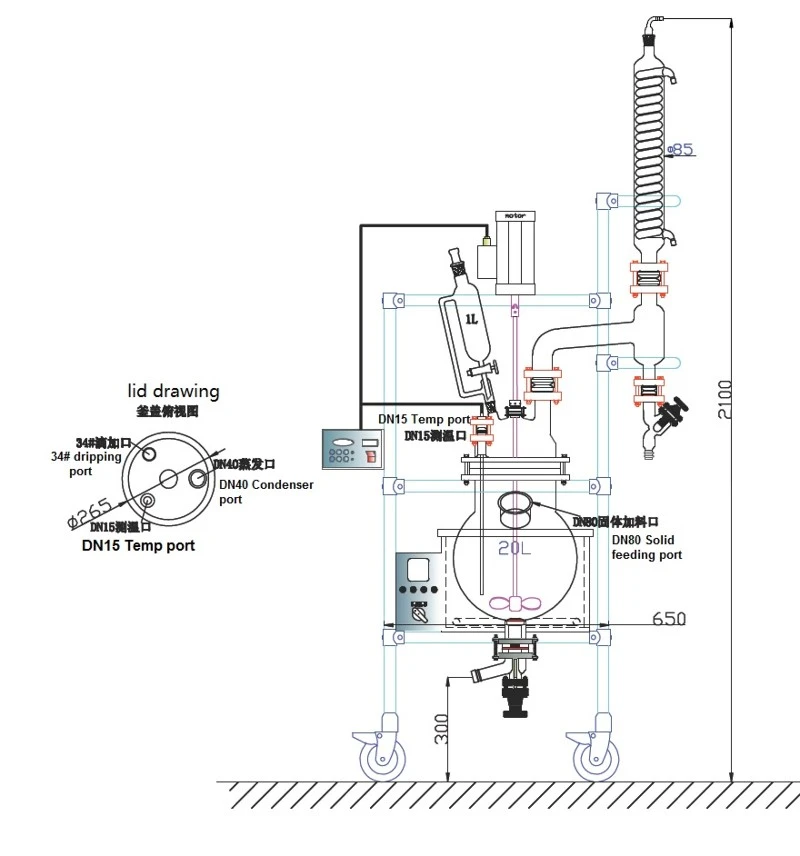 |
| Jacketed glass reactor drawing | Single layer glass reactor drawing |
Industrial Applications of a Glass Reactor
Now that you have understood the fundamental differences between the single-layer and jacketed glass reactors, let's focus on their applications. Glass reactors are used across multiple industries, including chemical, pharmaceutical, and food. The details of glass reactor applications across various industries are given below:
1. Maintaining Optimal Reaction Conditions in the Chemical Industry
Glass reactors play a crucial role in chemical industries due to their ability to precisely control the reaction environment. Glass reactors, especially the jacketed glass reactor, allow you to control the temperature accurately. It will enable you to control the temperature according to the reactants and the optimal conditions required for a high-quality product. Glass reactors offer multiple features, including crystallization, distillation, hydrogenation, and other chemical processes.
2. Synthesizing APIs in the Pharmaceutical Industry
Using glass reactors in the pharmaceutical industry proves to be a crucial part in the synthesis of Active Pharmaceutical Ingredients (APIs). Glass reactors provide full control over the quality of drugs and medicines. Generally, glass reactors are used in pharmaceutical labs for critical research and development work. The durability of glass reactors prevents damage from extreme temperature differences.
3. Food Processing
Glass reactors are responsible for ensuring high-quality and purity in the food industry. Both single-layer and jacketed glass reactors are involved in the production of natural and artificial flavours. These reactors are also used to manufacture various additives, flavorings, and essential compounds for food preservation.
4. Cosmetic Industry
The cosmetic industry utilizes glass reactors to manufacture and develop special fragrances, perfumes, and other compounds. The versatility of glass reactors plays a crucial role in the development and manufacturing of cosmetic products.
Wrapping it Up!
The choice between single-layer and jacketed glass reactors depends on your requirements and needs. If you need precise control over temperature, go for jacketed glass reactors. These reactors are equipped with an outer layer(jacket), which contains the heating or cooling medium. Advanced equipment is used to circulate the temperature control medium around the glass reactors. As a result, you can have complete control over the reaction temperature. On the other hand, single-layer glass reactors may not have precise temperature control, but are cost-effective. Single-layer glass reactors are the most basic glass reactors with a straightforward working.
If you are looking to go a step beyond in terms of quality and production capacity,XI'AN RICH SMART TECHNOLOGY CO.,LTD is the right place. We will help you achieve unmatched industrial efficiency and provide you with superior glass reactors. Our manufacturing capabilities allow us to produce high-quality equipment and deliver it right on time.


Confused about which type of glass reactor is best for you? Contact us, and our experts will provide you with experience-based guidance tailored to your specific needs.
Email:info@richtechpm.com
Tel:+86-13072962429
FAQs
Q:1 How does a Jacketed glass reactor ensure precise temperature control?
A: A jacketed glass reactor is equipped with an outer jacket that is used to circulate a heating or cooling medium. As the reaction proceeds, the medium circulates close to the inner chamber and maintains the ideal temperature. It allows you to adjust the thermal conditions as per the requirements of the reactants and the reaction.
Q:2 Can I use glass reactors in extreme temperature conditions?
A: Yes, glass reactors, both single-layer and jacketed, can be used in extreme temperature conditions. However, you need to ensure that the temperature is not above the tolerated limit. Additionally, avoid exposing the glass reactor to a significant temperature difference. Doing so can lead to thermal shock and damage the inner chambers of the glass reactor.
Q:3 What are the safety precautions when working with a glass reactor?
A: Following all the safety precautions is crucial to ensure the long life of glass reactors. Additionally, it reduces the risk of damage to the operating staff. Necessary safety precautions include the use of PPE kits, working under tolerated pressure and temperature limits, and regular maintenance.
Q:4 Do I need proper training to operate a glass reactor?
A: Yes, you need proper training before operating on glass reactors. The training will provide you with essential knowledge to use the glass reactors with efficiency. It will save you from accidents and also save the equipment from malfunctions. Having a trained staff working on glass reactors also ensures higher efficiency and quicker maintenance.
Resources
https://kjhil.com/guide-to-different-types-of-glass-reactors/
https://www.franli.com/chemical-reactor-3/
https://kjhil.com/all-in-one-guide-to-choosing-the-right-jacketed-glass-reactor-system/
https://www.labrotovap.com/portfolio-item/30l-single-layer-glass-reactor/
https://www.laboaoequipment.com/products/jacketed-glass-reactor/200l-jacketed-glass-reactor
https://kjhil.com/the-ultimate-guide-to-glass-reactors-everything-you-need-to-know/
https://www.syrris.com/jacketed-glass-reactors/
https://www.ablazeglassworks.com/glass-jacketed-reactor/
https://www.labrotovap.com/chemical-laboratory-jacketed-glass-reactor-system/


