

Spray drying is one of the most versatile processes and which is widely used for converting aqueous solutions into solid powders of known particle size, moisture, and functional attributes. A pilot scale spray dryer will be one of the primary keys for scaling the process from laboratory experiments to actual industrial production. The intermediate equipment is critical for developing the product and process optimization and reducing risk before full-scale manufacturing.
Understanding Spray Dryer
Spray dryer involves converting a liquid or water-based solution into a dry powder through a process of evaporation of the solution with the help of a hot gas which is commonly air. It is most suitable for heat-sensitive materials and enables the formation of powders with particular properties. In a chamber, the liquid feed is atomized into fine droplets using a nozzle or rotary atomizer before it comes into contact with the hot drying gas. The vacant solvent or water evaporates rapidly, which leaves one with a dry product. It is particularly employed in the operations of pharmaceutical companies, food and firms producing and selling beverages, chemicals, ceramics and any organizations with a strict adherence to quality control.

What Is a Pilot-Scale Spray Dryer?
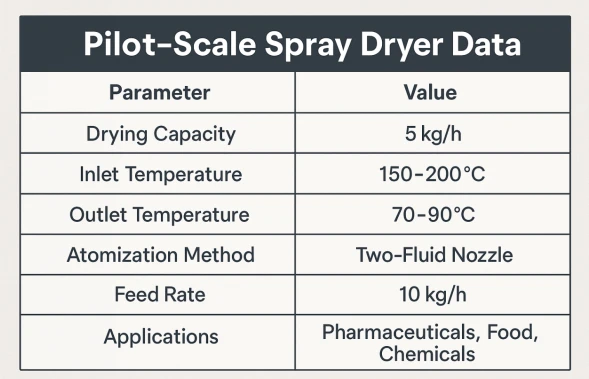
A pilot scale spray dryer is a reduced-dimensional version of a commercial spray drying system that is described by producing small amounts of powder but enough for something greater than lab size, but still considerably below full production. It enables researchers, engineers, and product developers to understand the behaviour of materials when the material is dried under spray drying conditions, as seen in commercial gas rotation. Pilot-scale spray dryers are scaled-down versions that almost reproduce the conditions at an industrial scale, including inlet and exit temperatures, flow rates, feed rates, and drying kinetics. Such dryers have superior control systems and sensors that allow acute attention to every parameter.

Key Components and Operation
The key equipment for a pilot-scale spray dryer consists of a feed tank, an atomizer (nozzle or rotary), a drying chamber, an air heating system, a cyclone separator or bag filter (for potato collection), and a control panel. The liquid formulation is pumped out of the feed tank and atomized into fine droplets. The hot air dries the moisture off as droplets move down the chamber, and the resulting powder is extracted at the bottom or through the cyclone. Pilot-scale units are characterized by flexibility. It frequently has an interchangeable nozzle, a variable blowing and heat output, as well as real-time data recording.
Why Is Pilot-Scale Spray Drying Important?
Process Optimization
Process optimization is one of the main reasons for using pilot-scale spray dryers. Setting up a new material to be spray-dried requires variables such as inlet temperature, atomization rate, feed concentration, and drying time. Pilot-scale equipment enables researchers to conduct experiments on these variables and find the best conditions to end up with, without the cost and material kilts that large-scale trials produce.
Product Development
Prior to manufacturing begins to introduce a certain product to the market, the manufactures have no way of telling how the ingredients used will behave when spray drying. A pilot-scale spray dryer makes it possible to produce prototype powders of desired particle size, solubility characteristics or moisture content. It is particularly imperative in business areas such as pharmacy, where bioavailability and precise measurement of doses are non-negotiable.
Scale-Up Validation
Processes that are scaled up from the lab to production can be challenging because of differences in heat transfer, airflow design, and residence time. Pilot-scale equipment offers an intermediate step where companies can see and address possible scale-up issues. It fills the gap by providing a more realistic simulation of industrial conditions than the benchtop models.
Cost Efficiency
Testing on a full-scale plant will be prohibitively expensive because of the high energy consumption, raw material cost, or downtime. Pilot-scale spray dryers are less expensive and do not pose the threat of expensive failures during commercial production.
Regulatory and Quality Assurance
In the pharmaceutical and food industries, regulatory agencies demand extensive documentation and validation of manufacturing processes. A pilot-scale spray dryer allows for producing reliable and reproducible data requirements for regulatory filing. It also allows for quality control and assurance testing under actual-world processing circumstances.
Applications Across Industries
Pharmaceuticals
In the pharmaceutical industry, spray drying is commonly used to obtain powders, produce inhalation products, clarify insoluble drugs, and produce controlled-release products. Pilot-level spray dryers allow formulation scientists to fine-tune the selection of the excipients, the choice of particles, and fluid content; all of which play a crucial role in the drug's effectiveness.
Food and Beverage
Over the years, the food industry has used spray drying to create powdered milk, coffee, flavors, and nutritional supplements. Food scientists use pilot-scale dryers to test various recipes and formulations and ensure that food taste, color, and nutrients are maintained before mass production.
Chemicals and Catalysts
The various uses of spray drying in the chemical industry have been enumerated below: The main use of the spray drying in the chemical industry is the production of pigments, detergents and catalysts. Pilot-scale dryers are used in a way to get some modifying results of particles such as porosity, surface area, and reactivity for final form of the product.
Ceramics and Advanced Materials
In ceramics and material science, spray drying is used to make uniform and free-flowing powder that can be pressed or sintered. Pilot-scale units are essential for controlling the shape and size distribution of the granules needed for constant ceramic properties.
Challenges in Pilot-Scale Spray Dryer
Though very effective, pilot-scale spray dryer also has its problems. It is hard to achieve a perfect scale-up because fine differences between airflow dynamics and the correlation of thermal gradients in systems still exist. Material behavior may alter when going to industrial units. Experienced operators and formulation scientists who can interpret data correctly and change processes accordingly are also required. Moreover, pilot units are still a significant investment, though cheaper than full-scale systems.

Future Trends in Pilot-Scale Spray Dryer
Pilot-scale spray dryer is also changing as industries continue to require faster times for product development and increased product uniformity. Modern systems involve process analytical technologies (PAT), automated feedback controls, and software capable of simulating full-scale outcomes from pilot data. There's also increased emphasis on energy efficiency and sustainable operation in developing such systems. Pilot-scale dryers are being made more modular and integrated with downstream units due to the rise in the adoption of continuous pharmaceutical manufacturing and the need for personalized nutrition.

Frequently Asked Questions (FAQs)
What is the difference between pilot-scale sprayer and a lab-scale dryer?
Spray dryer being a pilot scale is used for fewer experiments and tests and it processes only few grams in an hour. A pilot-scale spray dryer handles more significant volumes, ranging from kilograms to tens of kilograms per hour, and is applied to advanced process development and scale-up validation.
How does a pilot-scale spray dryer help with scale-up to industrial production?
It mimics the operating scenario of large systems for testing formulations and drying parameters. The collected data allows engineers to monitor how the product will perform when mass-produced without a risk of failure or inconsistency.
Which industries benefit the most from pilot-scale spray dryers?
It suggests that powder formulation can find useful applications in the pharmaceutical, food and beverages, chemical, ceramics and cosmetic industries. It can enhance properties such as particle size, moisture content and flow properties of an end product.
What are the main variables controlled in a pilot-scale spray dryer?
Some of the main critical parameters are the inlet and outlet air temperatures, air flow rate, atomising air rate, feed rate and feed concentration. He said that some of the factors affecting drying time include the temperature of the product and the final characteristics of the powder produced.
Can pilot-scale spray dryers be used for heat-sensitive products?
Yes, indeed, pilot-scale spray drivers are perfect for heat-sensitive products. They provide accurate control of drying conditions, allowing rapid evaporation at relatively low product temperatures to retain bioactivity or flavor.
What is the typical output capacity of a pilot-scale spray dryer?
The output also varies from model to model and configuration, but typically ranges from a few hundred grams to 25 kg of dry powder per hour.
Is pilot-scale spray drying expensive?
Although pilot-scale spray drying systems are considerably cheaper than full-scale production, they are nevertheless a relative investment. Nevertheless, they save money long-term, reducing wasted materials and mistakes that may occur with full-scale production.
Are pilot-scale spray dryers customizable?
Most units feature modular components, interchangeable nozzles, and programmable control systems. This flexibility helps them to manage a broad spectrum of materials and formulations.
Final Thoughts
When companies invest in pilot-scale spray dryer, they are more likely to be innovative, flexible, and successful in the competitive market. Without having this knowledge of how materials behave in a controlled drying environment, they reduce risk and increase efficiency before they invest in industrial-scale spray drying.

Reference & Resources
ACME Filtration. (n.d.). Pilot spray dryer. ACME Filtration. https://acmefil.com/pilot-spray-dryer/
Spray Tech Systems. (n.d.). Pilot spray dryer: A guide for small-scale to large-scale industries. https://spraytechsystem.com/pilot-spray-dryer-a-guide-for%20small-scale-to-large-scale-industries.html
ESDT. (n.d.). ESDT-10 pilot scale spray dryer. https://www.spray-dryer.com/esdt-10-pilot-scale-spray-dryer
Zhang, Y., Jin, L., Lin, X., Wei, W., & Zhou, W. (2023). Investigation of milk powder production using pilot-scale spray drying: Process optimization and quality analysis. Case Studies in Chemical and Environmental Engineering, 38, 100567. https://doi.org/10.1016/j.cscee.2023.100567


