

What are the integration requirements for a Boiling Fluid Bed Dryer with other equipment?
As a supplier of Boiling Fluid Bed Dryers, I've witnessed firsthand the importance of seamless integration with other equipment in various industrial processes. The Boiling Fluid Bed Dryer, known for its efficient drying capabilities, often needs to work in tandem with other machinery to achieve optimal results. In this blog, I'll delve into the key integration requirements for a Boiling Fluid Bed Dryer with other equipment.
Compatibility of Material Handling Systems
One of the primary integration requirements is the compatibility of material handling systems. The Boiling Fluid Bed Dryer typically receives raw materials from upstream equipment and transfers the dried products to downstream processes. Therefore, it's crucial to ensure that the material handling equipment, such as conveyors, feeders, and hoppers, can work smoothly with the dryer.
For instance, the feeding rate of the material into the dryer should be well - controlled. If the feeding rate is too high, the dryer may not be able to dry the material effectively, leading to uneven drying and potential quality issues. On the other hand, if the feeding rate is too low, the dryer may operate inefficiently, wasting energy and time.
The conveyor system used to transport the material to the dryer should also be designed to match the dryer's inlet requirements. The size, shape, and capacity of the conveyor should be selected based on the characteristics of the material and the dryer's throughput. Additionally, the conveyor should be able to handle the material gently to prevent breakage or degradation, especially for fragile or heat - sensitive materials.
Integration with Heating and Cooling Systems
The Boiling Fluid Bed Dryer relies on a heating system to provide the necessary heat for drying. Integrating the dryer with an appropriate heating system is essential for efficient operation. The heating system can be powered by various energy sources, such as steam, electricity, or gas.
When integrating the dryer with a steam - heated system, the steam supply pressure and temperature need to be carefully regulated to ensure consistent drying performance. The steam pipes should be properly insulated to minimize heat loss and prevent condensation. In the case of an electrically - heated system, the power supply should be stable, and the heating elements should be selected based on the dryer's power requirements.
After the drying process, the dried material may need to be cooled down before further processing or packaging. Integrating the dryer with a cooling system is necessary to achieve this. The cooling system can be a fluidized bed cooler or a conventional air - cooling system. The cooling rate should be controlled to prevent thermal shock to the material, which could affect its quality.
Connection with Dust Collection Systems
During the drying process in a Boiling Fluid Bed Dryer, a significant amount of dust may be generated. To meet environmental and safety regulations, as well as to prevent product contamination, it's essential to integrate the dryer with an effective dust collection system.
The dust collection system should be able to capture the dust particles efficiently. Common types of dust collection systems include cyclone separators, bag filters, and electrostatic precipitators. The selection of the dust collection system depends on the characteristics of the dust, such as particle size, concentration, and chemical properties.
The connection between the dryer and the dust collection system should be air - tight to prevent dust leakage. The dust collected by the system should be properly disposed of or recycled, depending on its nature.
Compatibility with Control Systems
Modern industrial processes often require precise control and monitoring. Integrating the Boiling Fluid Bed Dryer with a control system is crucial to ensure stable operation, optimize energy consumption, and improve product quality.
The control system can regulate various parameters of the dryer, such as temperature, pressure, airflow, and feeding rate. It can also monitor the performance of the dryer and other associated equipment in real - time. For example, sensors can be installed in the dryer to measure the temperature and humidity of the drying air, as well as the moisture content of the material.
The control system should be compatible with the control systems of other equipment in the production line. This allows for centralized control and coordination of the entire process. For instance, if the dryer is part of a larger drying and granulation line, the control system should be able to communicate with the granulator, conveyor, and other equipment to ensure a smooth and efficient operation.
Integration with Other Drying Equipment
In some cases, the Boiling Fluid Bed Dryer may need to be integrated with other types of drying equipment to achieve specific drying goals. For example, it can be combined with a Closed Loop Spray Dryer for materials that require both spray - drying and fluid - bed drying processes.

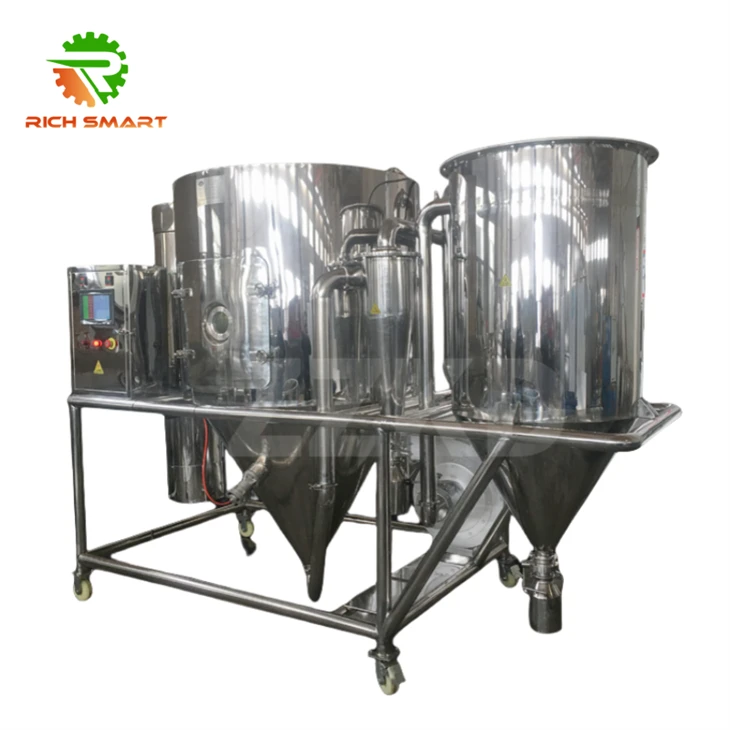
The integration of different drying equipment requires careful consideration of the material transfer between them. The material characteristics, such as particle size, moisture content, and flowability, may change after each drying step. Therefore, the transfer system should be designed to handle these changes and ensure a seamless transition between the different drying processes.
Another example is the integration with a T Frame Freeze Dryer Lyophilizer. Freeze - drying is a gentle drying method suitable for heat - sensitive materials. Combining a Boiling Fluid Bed Dryer with a freeze dryer can be beneficial for materials that require an initial pre - drying step followed by a final freeze - drying step to preserve their quality.
Integration with Product Packaging Equipment
Once the material is dried, it needs to be packaged for storage or transportation. Integrating the Boiling Fluid Bed Dryer with product packaging equipment is the final step in the production process.
The packaging equipment should be able to handle the dried material efficiently. The packaging speed, size, and type should be selected based on the product requirements and market demand. The transfer of the dried material from the dryer to the packaging equipment should be smooth to prevent product loss or contamination.
Conclusion
Integrating a Boiling Fluid Bed Dryer with other equipment is a complex but necessary task to achieve efficient, high - quality, and environmentally friendly industrial drying processes. By considering the compatibility of material handling systems, heating and cooling systems, dust collection systems, control systems, and other related equipment, we can ensure that the dryer operates seamlessly within the production line.
If you are in the market for a Boiling Fluid Bed Dryer or need advice on integrating it with other equipment, our team of experts is here to help. We have extensive experience in providing customized drying solutions and can assist you in optimizing your production process. Contact us today to start a discussion about your specific requirements and explore how our Boiling Fluid Bed Dryer can be integrated into your production line for maximum efficiency and quality.
References
- Mujumdar, A. S. (Ed.). (2014). Handbook of industrial drying. CRC press.
- Perry, R. H., & Green, D. W. (Eds.). (2007). Perry's chemical engineers' handbook. McGraw - Hill.
- Masters, K. (1991). Spray drying handbook. John Wiley & Sons.